Film and cinema theory have long brought up the idea of the audience as “voyeur”, with an emphasis on the audience’s illusion of participation in
Read more
Just another WordPress site
Film and cinema theory have long brought up the idea of the audience as “voyeur”, with an emphasis on the audience’s illusion of participation in
Read moreThe conception of a visual language that moves from a visual space into a kinetic space seems tenuous at best, and though Giuliana makes these
Read moreI am sure that my reading of this week’s texts has been wildly misinterpreted, but while absorbing lessons of cinema and architecture throughout these selected
Read more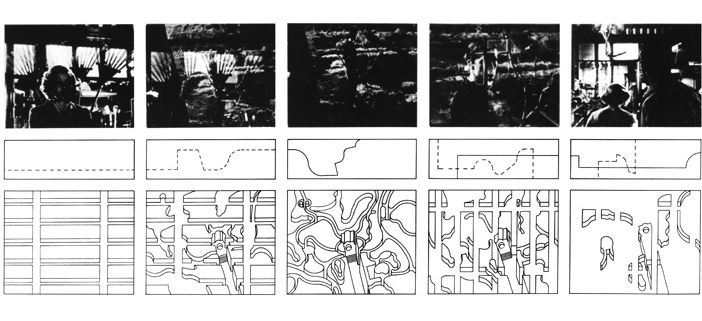
Bernard Tschumi – Screenplays. 1976 – Resistance gives way to re-sequencing, which in turn allows for infinite event. The best architectures, at least in relation to human
Read moreIn “Site-seeing: Architecture and the Moving Image”, Giuliana Bruno describes how the introduction of cinema brought a new spatio-visuality (Pg. 2) She explains how the new
Read more
In describing the cinematic nature of architecture, the architecture and design of cinemas, and buildings and city spaces as filmic devices or subjects, the authors
Read moreWhat is fascinating about Lynn’s analysis of the American television entering homes, perhaps, is how much of an invading force the television plays upon the
Read more
Lynn Spigel’s book, “Make Room for TV” is a cultural history of American television in the recent years following World War II (Spigel 1). Television
Read more
Above: The Hearth defines proximal relations, both socially, and in plan, at the Robie House. There is a level of control implicit in any object
Read moreIn ‘Toward the Sentient City’, Mark Shepard explains how mobile phones and personal computing devices such as iphones have become more important than architecture in
Read more